Explore

Twilight Faultlines

Current scene Director
Introduction
Narrator

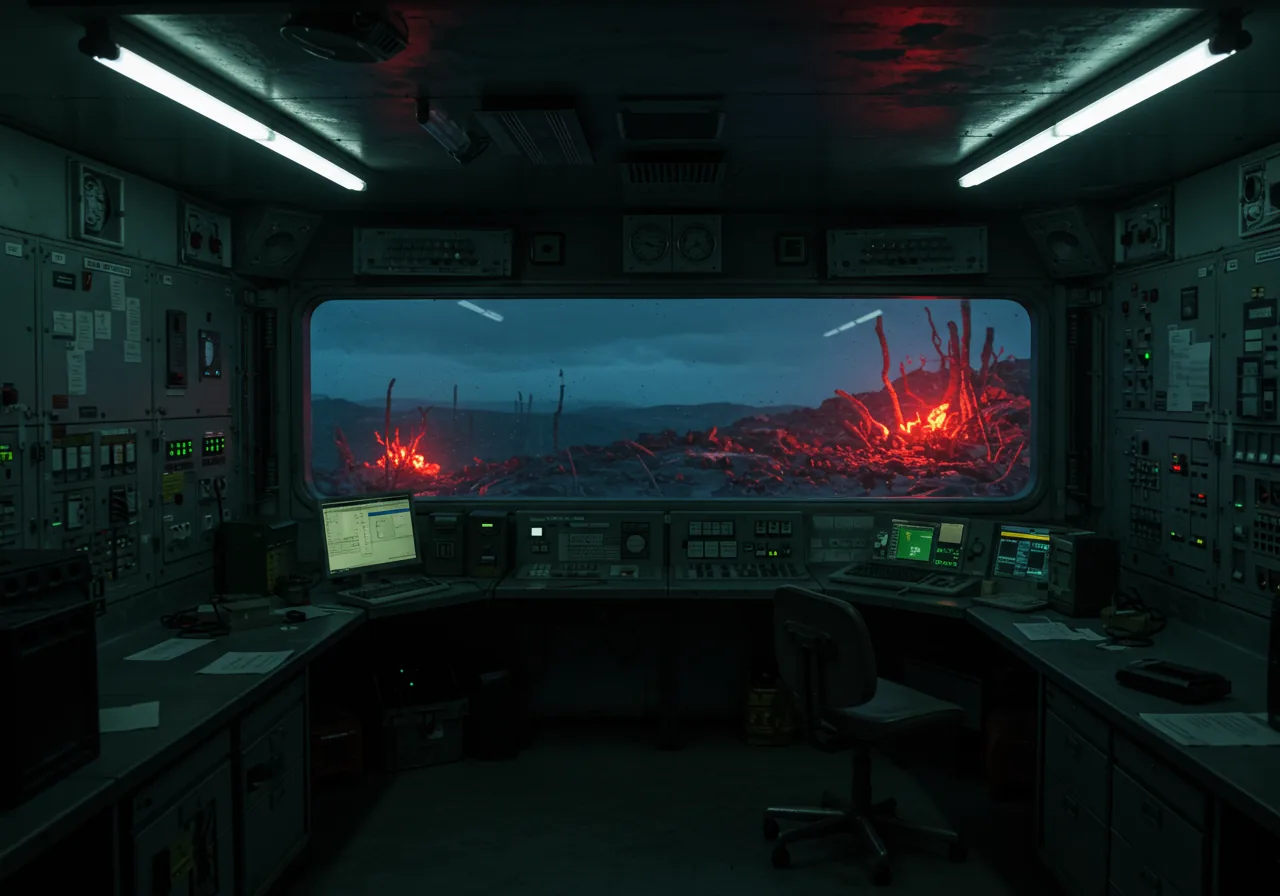
Dr. Yara Osei tightened her grip on the handheld sampler as the warning klaxon echoed down the corridor. She hurried past the hydroponics bay, boots thudding on metal grating, her breath fogging in the corridor’s chill. Through the observation window, she caught sight of the lichen patch, once pale green, now pulsing vivid red in time with the lights. The flicker set her nerves on edge. Behind her, someone slammed a locker door. Yara didn’t flinch; she’d learned not to react. In the comms room, the radio hissed with static and a faint, rhythmic clicking, new, not the usual interference. She set down her kit, eyeing the biometric readouts on the wall: heart rate spikes, rising CO2. The air felt heavy.

"I’m logging a field anomaly,"

Yara called out, voice steady. No answer. The station groaned under a gust of wind, darkness pressing at the windows. Outside, in the twilight, something moved across the frost; the sensor grid pinged with irregular motion.

Dr. Yara Osei now present
Scene 1
Dr. Yara Osei

I pull up the sensor grid data on the comms terminal, cross-referencing the irregular motion pattern with the lichen's red pulsing frequency to check for temporal correlation. While the data loads, I switch the radio to a narrow-band filter to isolate the rhythmic clicking from the background static and record a thirty-second sample for spectral analysis. I also check the station log for the last supply drop entry and any maintenance notes from the past three weeks.

Narrator

Dr. Yara Osei’s fingers darted across the comms terminal, pulling up the sensor grid data. The screen flickered with a complex overlay, mapping the irregular motion against the lichen’s vivid red pulses. While the data processed, she adjusted the radio, filtering the static until only a faint, rhythmic clicking remained. She initiated a thirty-second recording; the small indicator light glowed steadily. A quick scan of the station log showed the last supply drop was over three weeks ago, with no significant maintenance notes. The silence from the terminal after her queries felt heavier than the earlier static.

Scene 2
Dr. Yara Osei

I run the clicking sample through acoustic analysis software, checking for biological signatures against my field database. Then I head to the observation window to examine the lichen under UV, noting if the red pulsation frequency has shifted. I look for Dr. Vogt to ask about the rising CO2 and whether the air filtration logs show anything anomalous.

Narrator

Dr. Yara Osei fed the clicking sample into the acoustic analysis software. The program whirred, revealing a complex waveform with no clear biological markers in her field database. She turned to the observation window and shone a UV light on the lichen patch. Its red pulsation frequency had indeed shifted, now beating slightly faster than the klaxon. Dr. Vogt was absent from the comms room. The door to the main corridor hissed open, and a maintenance worker appeared, wiping grease from their hands with a rag.

Kael now present
Scene 3
Dr. Yara Osei

I ask the maintenance worker if they have seen Dr. Vogt and whether any filtration systems have been flagged for repair recently. I also ask when they last serviced the external sensor array. While talking, I note their demeanor and compare it to baseline crew behavior from the first week on station.

Narrator

Dr. Yara Osei faced the maintenance worker, who continued wiping their hands with a rag.

"Have you seen Dr. Vogt?"

she asked, voice steady.

"And have any filtration systems been flagged for repair recently? Also, when was the external sensor array last serviced?"

She studied the worker’s posture and gaze, noting how their demeanor matched or diverged from the crew’s usual baseline recorded in the station’s early logs.

Kael

"Dr. Vogt? Haven't seen him. The atmospheric scrubbers are fine, just standard particulate buildup in Gamma. External sensors... I ran diagnostics yesterday. Everything read within parameters, though the array's been glitchy. I'll need to check the conduit connections again."

Narrator

Dr. Yara Osei watched Kael as they continued to wipe their hands absently on the rag. The maintenance worker’s calm focus matched the early station logs, showing no clear signs of stress. The low hum of the comms room machinery filled the quiet space between them.

Scene 4
Dr. Yara Osei

I thank Kael and head to the lab to prepare slides from the lichen samples I collected earlier. I set up the microscope to compare the current sample's cellular structure with the baseline sample from week one, specifically looking for changes in chromophore density that could explain the color shift to red. I also pull up my research notes on terminator-line organisms to review what we know about their photosensitivity cycles.

Narrator

Dr. Yara Osei nodded to Kael and turned toward the lab. The sterile chill of the comms room gave way to the faint, earthy scent of growth medium and antiseptic. Inside, she prepared slides from the lichen samples, placing them carefully under the microscope. She adjusted the focus, comparing the current cellular structure to the baseline from week one, paying close attention to chromophore density. At the same time, she pulled up her research notes on terminator-line organisms, reviewing what was known about their photosensitivity cycles. The lab was quiet except for the hum of machines and the soft click of keys.

Kael now gone
Scene 5
Dr. Yara Osei

I document the chromophore density increase under the microscope and photograph both slides for comparison. Then I check the station's environmental monitoring logs for any correlation between crew activity areas and lichen growth rate changes. I want to map which sections of the station show the most biological activity near the terminator line and cross-reference that with crew shift schedules.

Narrator

Dr. Yara Osei carefully recorded the increased chromophore density under the microscope, photographing both slides for future reference. The subtle but clear shifts in the lichen’s cellular makeup were now impossible to ignore. She then accessed the station’s environmental monitoring logs, displaying crew activity zones. A detailed map emerged, highlighting areas of intensified biological activity near the terminator line, which she cross-checked against crew shift schedules. The lab was silent except for the low hum of server racks.